Is 2026 actually the worst year to buy a home? If national headlines are your main source of information, it can absolutely feel that way. Rates feel high. Prices feel high. There is constant talk about a correction, a crash, or waiting for things to settle down.
But national news is not local real estate. What is happening in Florida, Arizona, Miami, Denver, or Detroit is not automatically what is happening here. The Portland real estate market is made up of dozens of very different micro-markets, and that distinction matters if you are deciding whether to buy, rent, sell, or delay a move.
The honest answer is not that everybody should rush out and buy. Some people absolutely should wait. But for financially prepared buyers with a three to five year timeline, this may be a much more strategic buying window than the headlines would have you believe.
National Headlines Versus Local Reality
The biggest mistake buyers make right now is treating the housing market as one giant national thing. National reports blend data from markets with completely different job bases, migration patterns, inventory levels, climate risks, taxes, and housing supply. Once you average all of that together, you lose the story that matters most: what is happening where you want to live.
That is especially important in the Portland real estate market. The experience can change by city, neighborhood, street, home condition, price range, and property type. A beautifully updated historic home in inner Northeast Portland does not behave the same way as an outdated property farther from a major employment center. A new construction home in Happy Valley is not the same market as acreage in Oregon City.
So no, this is not a frozen market where every seller is panicking and every buyer is sitting on the sidelines. The local picture is more balanced and more nuanced than that.
Portland Real Estate Market Conditions in 2026
Recent Portland metro MLS data tells a much more grounded story. Pending sales topped 2,400 in May 2026, up more than 6% from the same month a year earlier. People are actively buying homes. At the same time, new listings were down by as much as 11% year over year.
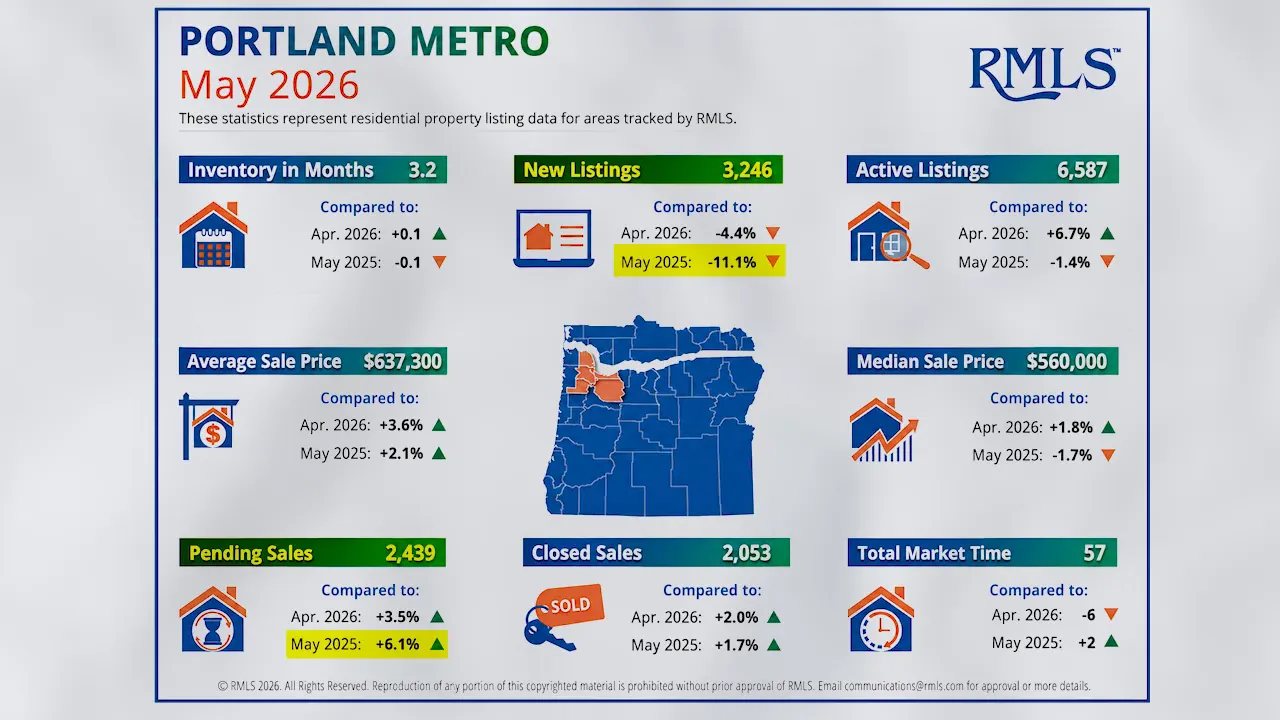
That combination matters. More active buyers and fewer new listings generally support pricing. It does not automatically mean every home receives multiple offers, but it certainly does not look like the kind of collapse that gets discussed on financial news channels.
The Portland real estate market in 2026 is closer to balanced than frenzied. The wild bidding wars of 2021 are largely gone. Buyers have more room to evaluate homes, inspect carefully, and negotiate when a property has been sitting. But a home that is priced correctly, presented well, and located in a desirable pocket can still move very fast.
That is happening on both sides of the river:
- On the Westside, well-positioned homes in Sherwood, West Linn, Beaverton, and Tigard continue to draw serious interest.
- On the Eastside, Happy Valley, Milwaukie, and Oregon City offer different combinations of newer homes, character, space, and commute options.
- In inner Northeast and Southeast Portland, well-priced historic homes can still move quickly because there is steady demand for that specific lifestyle.
There is another piece buyers need to understand. Many local homeowners bought or refinanced during the unusually low-rate period. They have substantial equity and mortgages that may be near 3%. A lot of them do not need to sell. When they decide not to list, that creates a supply constraint. It is seller behavior, not necessarily seller distress.
That is why elevated rates have not caused a wave of desperate price cuts across the Portland real estate market. Sellers who have flexibility can wait, and quality homes continue to find buyers.
Mortgage Rates and the Cost of Waiting
Buyers are not wrong to feel squeezed. During 2020 and 2021, 30-year mortgage rates dropped into roughly the 3% to 4.5% range. That was a once-in-a-lifetime anomaly, and it became everybody’s emotional baseline. Compared with that period, a rate around 6.5% feels painful.
But we have to put today’s rates in real historical context. Freddie Mac historical data shows that the long-term mortgage-rate average over more than 50 years is above 7%. Buyers in the late 1990s paid more than 7.5%. In the 1980s, rates approached 20%.
That does not make a 6.5% rate inexpensive. Monthly payments and purchase prices both matter. But it does mean waiting for a return to 3% or 4% rates may be waiting for something that simply is not likely to return anytime soon.
Most expectations point toward rates drifting somewhat lower over the coming years, mostly in the 6% range near term. Gradual improvement is different from a return to the pandemic rate environment. If rates do fall, pent-up demand can re-enter the Portland real estate market at exactly the same time. Competition increases, and buyers may end up paying more for the home itself.
A future refinance may be possible if rates improve. The purchase price you negotiate on closing day, however, is locked in. That is why the right question is not, “Will rates be perfect?” It is, “Can I comfortably own this home now, and does it fit my longer-term plan?”
Calculate the Full Cost of Waiting
Too many buyers evaluate only the future purchase price. That is incomplete math. The cost of waiting can include:
- The price movement of the exact kind of home you want
- The rent paid while you remain on the sidelines
- Whether rates actually change enough to improve your buying power
- The possibility of increased competition when rates decline
- The lifestyle cost of postponing a move that already fits your goals
No one has a crystal ball. Nobody can promise what the next 12 months will bring. But waiting is not free, and it should be a deliberate choice rather than a reaction to scary national headlines.
Portland Micro-Markets and Neighborhood Options
The Portland real estate market is not one market. It is a collection of hyper-local markets that can perform very differently from one another.
On the Westside, parts of Lake Oswego, Beaverton, and Tigard are showing some softening. That can create opportunity, especially for homes that are outdated, need work, or are not in the most competitive neighborhood pocket. At the same time, certain homes in those same cities are receiving multiple offers because they check the right boxes for the right buyers.
On the Eastside, inner Northeast and Southeast Portland often feel more competitive, especially for well-priced character homes. Yet quieter pockets still exist. Moving farther east toward Happy Valley or Oregon City can open up options for new construction, older charming homes, more land, or acreage that does not require a multi-million-dollar budget.
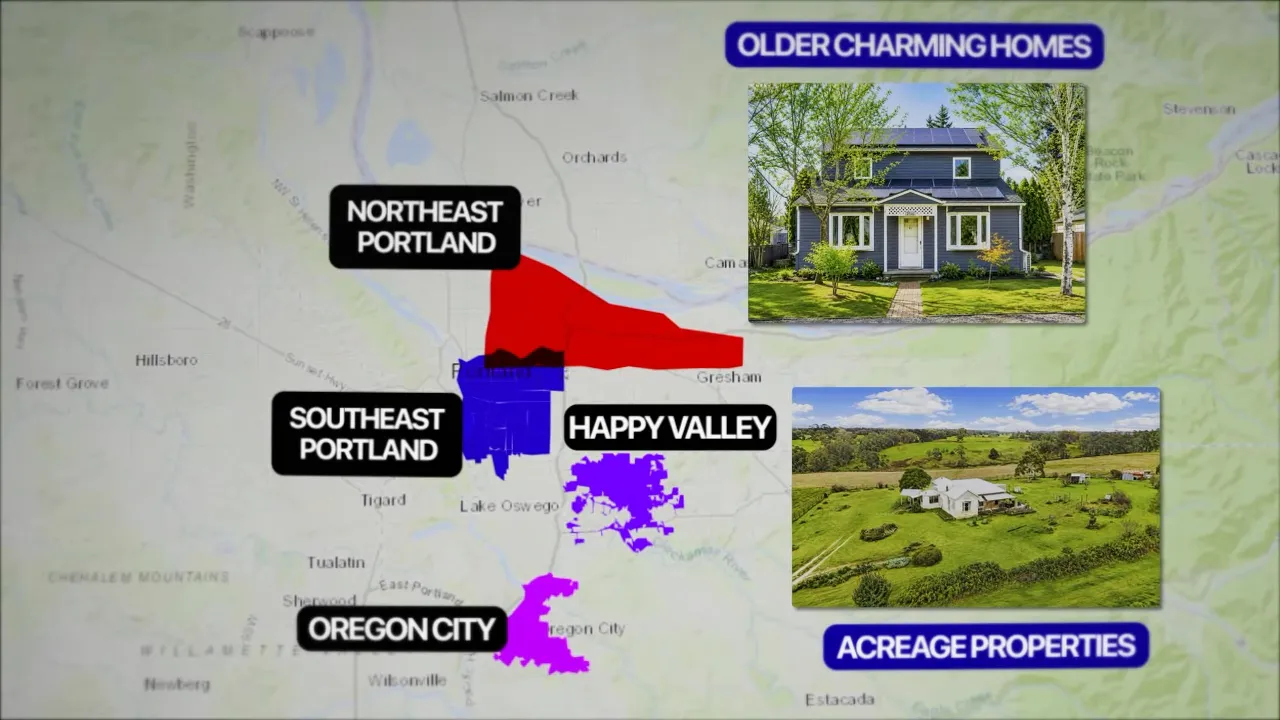
If you are moving to Portland, do not start with a list of city names alone. Start with the lifestyle you need. Commute, lot size, neighborhood feel, home style, access to employers, and long-term value all change depending on where you land.
Sherwood offers a small-town feel while continuing to grow. West Linn appeals to buyers looking for views and an established community. Beaverton, Tigard, Southwest Portland, and Northwest Portland provide a broad mix of home types while keeping access to downtown and the Silicon Forest. Milwaukie has walkable small-town charm. Happy Valley has a significant amount of newer construction. Oregon City offers a blend of downtown, suburbs, and acreage.
There is no cookie-cutter answer here, and that is one of the best things about buying in this metro. There is a deep range of neighborhoods and housing styles, each offering a genuinely different way to live.
Who Should Wait to Buy in Portland
I am going to be direct here. Buying is not automatically the right move simply because you are tired of renting or frustrated that you did not buy sooner. There are several situations where waiting is the smart decision.
Buyers With Income Uncertainty
If your job is unstable or there is genuine uncertainty around your income over the next 24 months, do not buy yet. A mortgage requires real qualifying strength. If the income is not dependable, the stress can arrive quickly.
Buyers Without Down Payment and Reserves
If you are still piecing together the down payment and closing costs, pause. In competitive pockets of the Portland real estate market, tight financing matters. Some areas, especially in Northeast and Southeast Portland, still involve cash offers and fast-moving listings.
Lenders in many local price ranges want to see reserves, commonly two to six months depending on the buyer’s financial situation. If the down payment depletes everything you have, you are not quite ready. Pressure buying is where bad decisions happen.
Buyers With a Short Timeline
If you may need to sell in a year, buying is not a strong strategy. Closing costs, title fees, moving expenses, and the normal costs of ownership mean a home is not a short-term play. If your relocation is temporary or your plans are uncertain, renting a great home in a great neighborhood for another year can be the wiser move.
Buyers Who Are Emotionally Rushed
Financially ready does not always mean emotionally ready. People who have spent two years waiting sometimes want to make up for lost time by moving too fast. That can lead to overbidding or choosing a good house in the wrong location.
The right home, at the right price, in the right neighborhood is worth more than rushing into a property you may regret in two years.
Who Is Well Positioned to Buy in Portland
The best-positioned buyer in the Portland real estate market is financially solid, has a three to five year or longer time horizon, and is focused on quality of life alongside stability. That buyer does not need a perfect market. They need a payment they can handle, a home that fits, and a neighborhood that makes sense for daily life.
There are also meaningful local demand anchors. Intel employs more than 22,000 people in the Hillsboro and Beaverton area and has committed $36 billion to its campuses there, including federal CHIPS Act funding. Nike has more than 15,000 employees at its Beaverton world headquarters. Columbia Sportswear, Tektronix, and Leupold & Stevens add to that employment base.
These are long-term employment anchors. Engineers, designers, and corporate professionals will continue to need homes within a reasonable commute of those campuses. That does not eliminate market changes, but it does create a foundation of demand that many markets do not have.
Hybrid work has also reshaped the map for buyers moving to Portland. With many local tech organizations operating on hybrid schedules, commuting two or three days a week can make places such as Sherwood, West Linn, Happy Valley, Milwaukie, and other metro communities more realistic choices than they were when everybody drove in daily.
For buyers coming from California, Texas, Arizona, or Florida, the Portland real estate market can offer a lifestyle and range of housing options that are difficult to find in comparable West Coast metros at similar price points.
Oregon also has no state sales tax. Measure 50 limits assessed-value increases used for property taxes to no more than 3% per year, offering more predictability around tax growth. For buyers accustomed to higher property tax structures elsewhere, that can be a meaningful part of the ownership calculation.
Clarity Beats Perfect Timing
The Portland real estate market in 2026 does not reward perfect timing. It rewards clarity.
Clarity about your income. Clarity about your reserves. Clarity about how long you will own the home. Clarity about what tradeoffs you are willing to make. And, especially if you are moving to Portland from out of state, clarity about which neighborhood actually fits your lifestyle.
Buying in a metro you have never lived in without specific local guidance can put you in the wrong neighborhood, with the wrong commute, the wrong house, or an unnecessary price premium. The buyers making smart moves are not the ones who perfectly guessed the next rate change. They are the people who understand what they need and act when their finances and timeline support it.
If you need more time, take it. Build the down payment. Strengthen reserves. Get clear on your budget. Learn the areas. There is no shame in waiting when waiting protects you.
But if you are ready, have a longer horizon, and are looking for a home that fits your life, do not let broad national panic make the decision for you. Get specific. The Portland real estate market is local, and the right answer is personal.
Portland Real Estate Market FAQs
Is the Portland real estate market crashing in 2026?
No. Current local conditions are better described as balanced. Pending sales are active, new listings have declined, and well-priced homes in desirable locations continue to move quickly.
Should I wait for mortgage rates to return to 3%?
Waiting for 3% or 4% mortgage rates may not be realistic. Those pandemic-era rates were unusual. Rates may gradually decline, but a lower rate environment could also bring more buyer competition.
Who should not buy a home in Portland right now?
Buyers with unstable income, limited down payment funds, inadequate reserves, a likely move within 12 to 18 months, or an emotionally rushed mindset should consider waiting.
What should I consider when moving to Portland?
Start with the lifestyle you need, including commute, home style, lot size, neighborhood character, budget, and long-term plans. Westside and Eastside communities offer very different housing and daily-life experiences.